Critical Advisory
If your wallet was drained in the last 24 hours, do not transfer any more funds into it. The wallet is cryptographically burned. Assume the attacker has persistent access via compromised seed phrases or unlimited token approval contracts.
The Anatomy of a Crypto Wallet Hack
The term "hacked" is often used broadly in the cryptocurrency space to describe any loss of funds. However, from a digital forensics perspective, true cryptanalysis-breaking "hacks" of underlying blockchain protocols (like Bitcoin or Ethereum) are mathematically near-impossible and exceedingly rare.
When a retail investor's wallet is "hacked," it almost universally means that the endpoint—the user's device, their security practices, or their interaction with a malicious smart contract—has been compromised. Understanding the specific mechanism of the compromise is the crucial first step in any investigation, because the mechanism dictates the digital footprint the attackers leave behind.
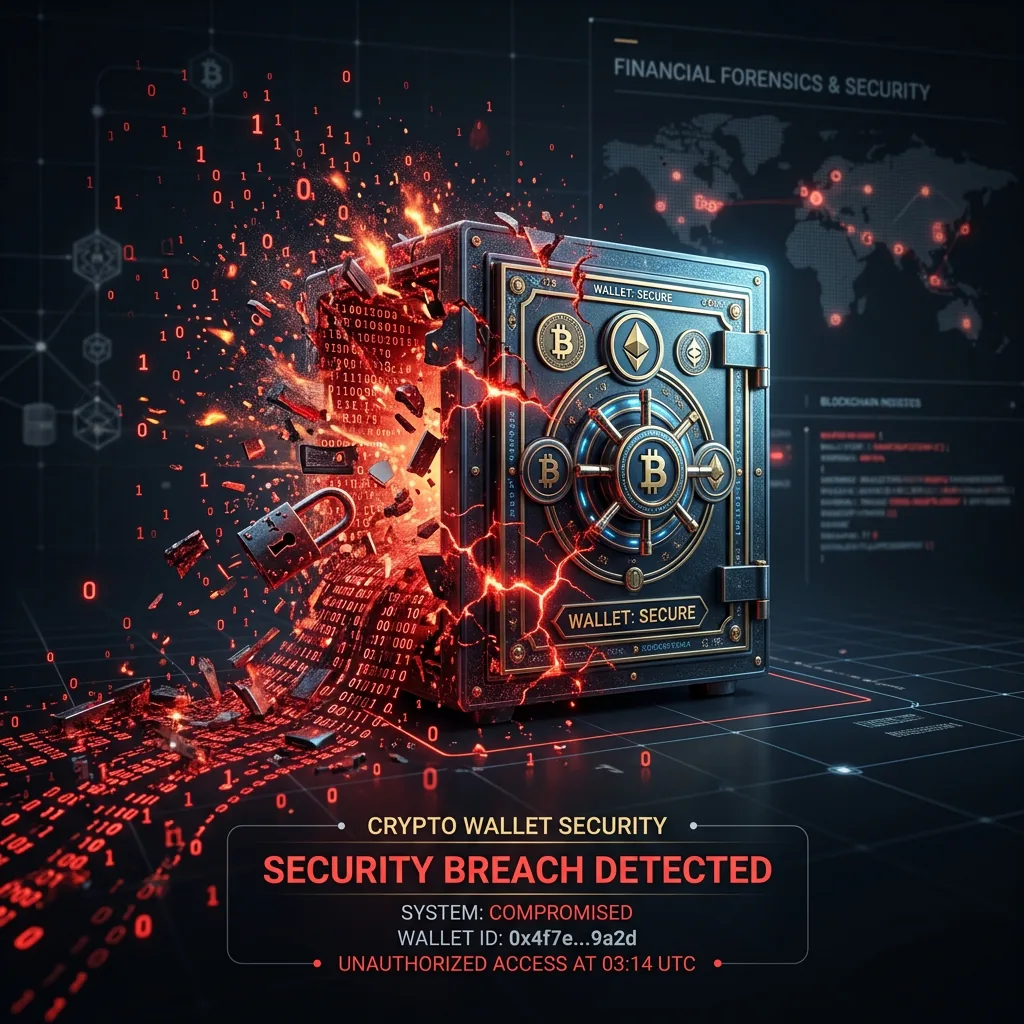
The immediate aftermath of a wallet drain is chaotic. Victims often scramble to contact customer support of non-custodial wallet providers (like MetaMask or Trust Wallet), only to realize that these entities have no administrative control over the blockchain and cannot reverse transactions. The decentralized nature of Web3 means that custody and security are entirely the responsibility of the end-user.
Common Types of Wallet Compromise
In our forensic investigations, we classify wallet compromises into three primary attack vectors. Identifying which vector was used is critical for tracing.
1. Seed Phrase / Private Key Exfiltration
Your 12 or 24-word recovery phrase is the master cryptographic key to your assets. If an attacker acquires this, they possess total control over your wallet across any device. This exfiltration typically happens through:
- Phishing Sites: Fake interfaces mimicking legitimate decentralized exchanges (DEXs) or wallet support portals that ask you to "verify" your wallet by typing in your seed phrase.
- Malware / Info-stealers: Malicious software (like RedLine Stealer) running silently on your PC that scrapes your clipboard, local files, and browser extensions for unencrypted private keys.
- Cloud Backups: Storing a screenshot of a seed phrase in iCloud, Google Drive, or Evernote, which is then compromised in a credential stuffing attack.
2. Malicious Smart Contract Approvals (Phishing)
This is currently the most pervasive attack vector in Web3. You do not need to give a scammer your seed phrase to lose your money. In the Ethereum Virtual Machine (EVM) ecosystem, tokens require you to grant "approval" to smart contracts to move funds on your behalf (e.g., when trading on Uniswap).
Scammers exploit this by directing victims to visually identical, fake dApps. When the victim connects their wallet, they are prompted to sign a transaction that looks routine. In reality, they are signing an `eth_sign` request or a `SetApprovalForAll` function, granting the scammer's contract infinite allowance to drain the victim's ERC-20 tokens or NFTs at will.
3. Centralized Exchange / Custodial Hacks (SIM Swapping)
If your funds were stolen from a centralized exchange like Coinbase, Binance, or Kraken, the attack vector is usually traditional Web2 account takeover. The most devastating form is the SIM Swap attack.
In a SIM Swap, attackers bribe or socially engineer a telecom employee to port your phone number to a SIM card they control. Once they control your number, they bypass SMS-based Two-Factor Authentication (2FA), reset your email passwords, lock you out of your exchange account, and instantly withdraw your balances to external, unhosted wallets.
Immediate Steps: Triage & Containment
If you discover an unauthorized outbound transaction, your first priority is containment. Do not panic, and do not immediately format your computer—you may destroy vital forensic evidence.
- Isolate the Network: If you suspect active malware (e.g., your mouse is moving on its own, or files are opening), disconnect the machine from the internet immediately.
- Revoke Approvals: If you suspect a malicious smart contract approval, use a clean device to connect your wallet to Revoke.cash or Etherscan's Token Approval tool. Immediately revoke any unlimited allowances to unrecognized contracts.
- Evacuate Remaining Assets: If you have staked assets or funds on different chains that the attacker hasn't found yet, use a clean device to create a brand new wallet (a "lifeboat" wallet) with a new seed phrase. Transfer all remaining assets to the lifeboat wallet instantly.
- Preserve Evidence: Take screenshots of the unauthorized transaction hashes, the wallet addresses they were sent to, and any suspicious links, emails, or telegram messages that led to the compromise.
How Blockchain Forensic Tracing Works
The blockchain is a public ledger. While scammers believe the pseudonymous nature of cryptocurrency protects them, the immutable reality of the blockchain is actually a forensic investigator's greatest asset. Every single movement of a stolen token is recorded permanently.
Professional blockchain forensics involves the deployment of enterprise-grade clustering algorithms (using software like Chainalysis or TRM Labs). We do not manually click through Etherscan; we use heuristics to map the attacker's entire digital footprint.

The investigation process focuses on following the funds to a centralized off-ramp. Scammers cannot pay their rent or buy luxury goods in stolen Tether (USDT). Eventually, they must convert the stolen cryptocurrency into fiat currency (USD, EUR, etc.). To do this, they almost always route the funds through a centralized exchange (like Binance, Kraken, or OKX).
Because these exchanges adhere to strict KYC (Know Your Customer) regulations, they hold the true, real-world identity of the scammer (their passport, ID, and bank account details). The goal of forensic tracing is to identify the exact deposit addresses at these exchanges where your stolen funds were sent.
Working with Law Enforcement
A forensic report is not a magic wand that automatically returns your money. It is an evidentiary tool designed to bridge the technical gap between your loss and law enforcement action.
Local police departments rarely possess the specialized training or software licenses required to trace cryptocurrency across cross-chain bridges and privacy mixers. When you present them with a professional, court-admissible forensic tracing report, you remove the investigative burden. The report provides law enforcement with the exact transaction hashes, the destination exchange, and the specific subpoenas they need to draft.
Once law enforcement subpoenas the centralized exchange, the exchange will freeze the scammer's account and turn over their identity documentation, opening the door for civil litigation or criminal asset forfeiture.
Securing Your Future Assets
Recovering from a hack is traumatic. To ensure it never happens again, you must upgrade your operational security (OpSec) to an institutional standard:
- Migrate to Hardware: Never store significant wealth on a software hot wallet (like MetaMask) installed on your daily browsing computer. Purchase a hardware wallet (Ledger, Trezor, Coldcard) directly from the manufacturer—never from a third party like Amazon.
- Compartmentalization: Use multiple wallets. Maintain a "Vault" hardware wallet that never connects to smart contracts and is only used for cold storage. Maintain a separate "Burner" hot wallet funded only with the exact amount needed for a specific DeFi transaction.
- Hardware 2FA: Replace all SMS and Authenticator App 2FA with physical security keys (like YubiKey) for your email and centralized exchange accounts. This mathematically prevents phishing and SIM swap attacks.
Disclaimer: The Forensics Pro provides investigative and research services. We do not provide legal advice, nor can we guarantee the successful recovery of stolen assets. Recovery depends entirely on law enforcement cooperation, jurisdiction, and the specific cash-out mechanisms used by the threat actors.