Evidentiary Standard
Our forensic reports are drafted to meet the strict evidentiary requirements of global law enforcement agencies (FBI, Europol, Interpol). We do not rely on public block explorers; our analysts utilize proprietary clustering databases to de-anonymize wallet addresses.
What is Blockchain Forensics?
When victims of cybercrime—whether through a business email compromise, a drained Web3 wallet, or a sophisticated relationship scam—lose cryptocurrency, they are often told by local police that the funds are "untraceable" and gone forever. This is a fundamental misunderstanding of how blockchain technology works.
Blockchain networks (like Bitcoin, Ethereum, and Solana) are public, immutable, distributed ledgers. This means every single transaction, down to a fraction of a cent, is permanently recorded and visible to anyone in the world. Blockchain forensics is the applied science of analyzing these billions of transactions to map the flow of illicit funds, attribute specific wallet addresses to known criminal entities, and ultimately identify the real-world identity of the thief.
The Myth of Absolute Anonymity
Cryptocurrency was originally designed to bypass the traditional banking system. For a long time, it enjoyed a reputation as the perfect tool for criminals because wallet addresses (like `1A1zP1eP5QGefi2DMPTfTL5SLmv7DivfNa`) contain no names, no social security numbers, and no geographic locations.
However, cryptocurrency is highly pseudonymous, not anonymous. While the address itself doesn't contain your name, its entire behavioral history is public. If an investigator can link a real-world identity to just *one* transaction involving that wallet, the pseudonymity collapses, and the entire financial history of that individual is laid bare.
Criminals cannot pay for their servers, bribe officials, or buy luxury real estate with raw Bitcoin. They must eventually convert the stolen cryptocurrency into fiat currency (USD, EUR). To do this at scale, they must use centralized cryptocurrency exchanges (CEXs) like Binance, Kraken, or Coinbase. These exchanges are heavily regulated and require stringent Know Your Customer (KYC) documentation—passports, driver's licenses, and facial recognition scans.
Our 4-Step Tracing Process
Professional blockchain tracing is a highly methodical process that requires a combination of algorithmic analysis and human intelligence.
1. Intake and Triage
The investigation begins with the initial transaction hashes—the exact moments the funds left the victim's control. We analyze these initial hops to determine the technical vector of the attack (e.g., was it a smart contract exploit, a direct transfer, or an exchange withdrawal?). We then run these addresses against global threat intelligence databases to see if they are associated with known advanced persistent threat (APT) groups like Lazarus.
2. Heuristic Clustering
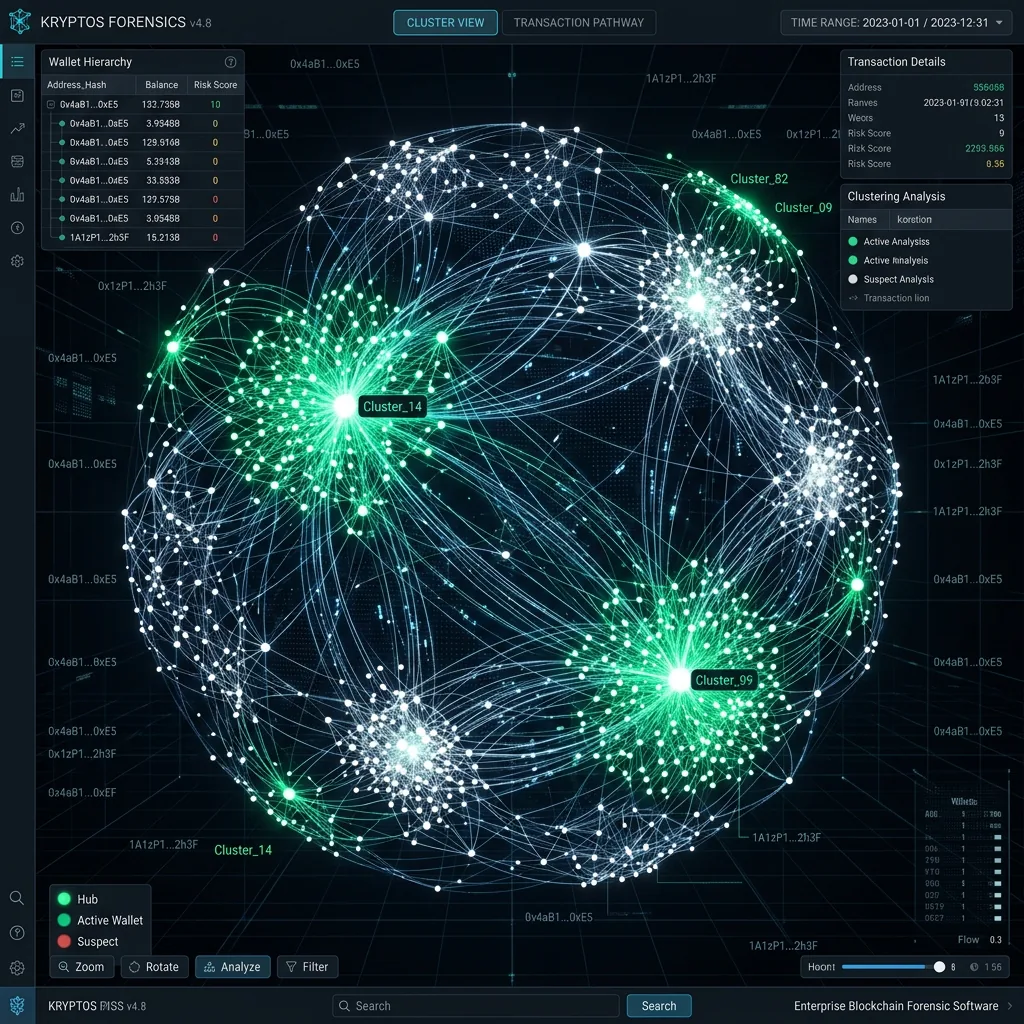
Using enterprise software (such as Chainalysis, TRM Labs, or CipherTrace), our investigators begin mapping the network. The software uses heuristic algorithms to identify "clusters." For example, if a scammer uses 50 different Bitcoin addresses to receive payments, but eventually consolidates all those funds in a single transaction to pay an exchange, the software automatically groups those 50 addresses into one single entity.
Defeating Peel Chains & Mixers
Scammers know that investigators are watching. To counter this, they deploy advanced obfuscation techniques.
Peel Chains: A scammer steals 100 BTC. Instead of sending it directly to an exchange, they send 1 BTC to an exchange, and 99 BTC to a new address they control. From that 99, they send 2 BTC to an exchange, and 97 BTC to a new address. This creates a massive chain of transactions "peeling" off small amounts to evade automated alerts. Our tools automatically unravel peel chains, identifying the ultimate destination of the core funds.
Cross-Chain Bridges: To break the trace, a scammer might take stolen Ethereum, use a decentralized bridge protocol (like Thorchain or Stargate), and convert it into Bitcoin on an entirely different blockchain. Forensic investigators must use multi-chain analysis platforms to track the exact timestamp and volume of the swap, picking up the trail on the new blockchain.

Identifying the Cash-Out Point
The ultimate objective of any tracing investigation is to follow the funds to a centralized "cash-out" point. This is an exchange, a fiat off-ramp, or a regulated OTC (Over-The-Counter) desk.
When stolen funds are deposited into a Binance or Kraken address, the blockchain trace technically ends. The funds are absorbed into the exchange's massive hot wallets. However, the *legal* trace has just begun.
We document the exact transaction hash, the precise timestamp, the receiving address belonging to the exchange, and the specific fiat equivalent value. We compile this data into a comprehensive, sworn affidavit and investigative report.
The Law Enforcement Handoff
It is critical to understand that private investigators cannot freeze exchange accounts or compel an exchange to hand over user data. Only law enforcement or court orders can execute asset freezes.
However, local law enforcement agencies are overwhelmed and lack the software to trace crypto themselves. When you hand them a police report saying "I lost Bitcoin," the case is often filed and ignored.
When you hand law enforcement our forensic report, you are handing them a completed investigation. The report specifically tells the detective: *"The stolen funds are located at Binance Account X. Here is the draft preservation request and the subpoena wording required to seize the funds."* This drastically increases the probability of law enforcement taking action, freezing the scammer's account, and identifying the perpetrators.
Is Your Case Viable for Tracing?
Not every case is viable for forensic tracing. Our triage process evaluates several factors:
- Total Loss Amount: Due to the high cost of enterprise software and analyst hours, tracing extremely small amounts (under $10,000) is rarely economically viable for the victim, and law enforcement is less likely to issue international subpoenas for low-level crimes.
- Time Elapsed: The faster a trace is initiated, the higher the chance of freezing the funds at an exchange before the scammer withdraws them to a local bank account.
- Chain Used: While we track across 30+ blockchains, certain highly obscure chains or extreme privacy coins (like Monero) pose significant analytical challenges.
If you have suffered a significant loss, do not write it off. The blockchain never forgets. Submit your transaction hashes below for a preliminary viability assessment.